

In 1967, the University of Missouri-St. Louis presented its first graduating class of 205 students. Since then, the university has issued more than 125,000 degrees to over 119,000 individuals (75% whom live and work in Missouri). Today, the campus has expanded to over 350 acres in suburban St. Louis County. UMSL graduates can be found in all 50 states and in countries around the world. The University of Missouri-St. Louis continues to be a vital part of the city, providing affordable education and a vast network of connections that set students up for successful careers. You can take the student out of UMSL, but you cannot take the UMSL out of a student.
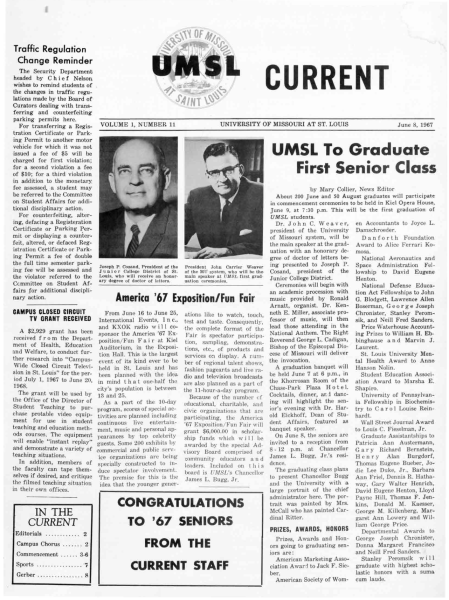
June 8, 1967
For many, the highlight of one’s undergraduate is the end and walking the stage at graduation. Crossing the finish line simultaneously brings relief and new worries/challenges. The Class of 2026 Commencement will be on May 15 and 16. Not only is a new generation of students graduating, but this year also marks the 50-year Golden Reunion of the class of 1976 to honor their legacy. The class of 1976 will spend two meaningful days reconnecting with classmates, revisiting campus and discovering how UMSL has evolved over the last five decades. As a student in the 2026 graduating class, I was honored to get to speak with golden alumna Linda Brown Reed about her accomplishments and the many changes UMSL has undergone.
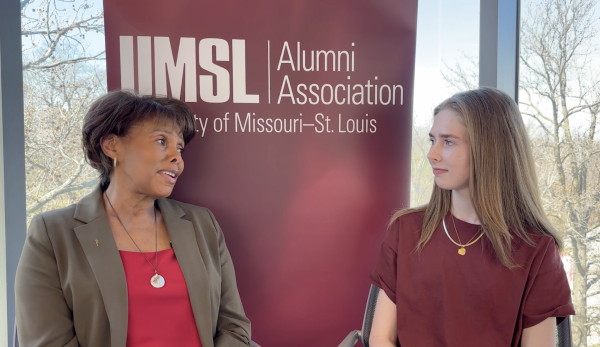
Linda Brown Reed graduated from UMSL in 1976 with a degree in English, becoming the first in her family to earn a college degree. She then earned a full scholarship from Washington University School of Law, becoming one of the earliest female UMSL undergrads to earn a law degree. As a practicing attorney in St. Louis for over 40 years, alumna Brown Reed has also served 12 years as president of the African American Chapter of the Alumni Association and 10 years as a member of the Alumni Association Governing Board, among many other community roles. Talking with alumna Brown Reed about her experience at UMSL and her advice for students was very enlightening. Here is what she had to say.
What does being a Golden Grad mean to you and what does being a part of this experience look like?
“I’m still here, so that’s a beautiful thing. I really didn’t even realize I was coming up on my fiftieth anniversary. I’m excited to be back on campus. I’m excited to be part of the graduation ceremony and to see folks who were here when I was here. I’m really looking forward to the ceremony itself and to the two luncheons.”
How has UMSL changed since your graduation?
“Well, the campus- it is a different campus here. It has expanded so much. We didn’t have an engineering college and I know it’s a department at this point, but we didn’t have that. We didn’t have nursing when I was here and Optometry was not here. The campus has changed immensely and has expanded out into the community. An example of that is the Bridge program that prepares high school students to transition to college. That’s a wonderful thing. There’s so much innovation, so many new things going on here.”
What feelings do you remember most from your graduation day?
“It was excitement. It was hard for me to believe that I had made it because prior to coming to UMSL, I had attended other colleges and had mishaps, or missteps, you could say. I got here and UMSL was the best fit for me. I’m sure after having those missteps, folks thought, ‘I don’t know what Linda is going to do,’ but I came here and I did it. I graduated August 1, 1976 and 14 days later, I started law school at Washington University. So it was just a lot of excitement and gratitude for what this university had done for me.”
As my class and I prepare to graduate, what advice do you have for us?
“One thing I want to say is to remember the folks that are going to come behind you and be willing to reach back and help pull someone up. We all need some help, so please don’t forget the ones who are coming behind you. And don’t forget your alma mater because the university needs your help as well, in any way that you can contribute.”
What advice do you have regarding the transition from undergrad to graduate school?
“Be prepared. Get to know as much as you can about what you’re going to do next. Talk to people, network- that networking is very important. It’s amazing what you can pick up in talking to someone. You won’t even realize when you start the conversation that there’s going to be something fruitful, something that you can use later on. It’s amazing. Become involved in activities with the profession that you plan to become a part of. Participate in the events, get to know some of the people, because some of that saying about it’s not what you know, it’s who you know? Well, you’ve got to know some stuff too, but knowing people is a good thing because often, you need references.”
What has been your biggest hurdle as a Black female attorney?
“Back then, there were not many Black attorneys, period. My first job was as a public defender in St. Louis County and in the courthouse, you just did not see many Black people there. There were no Black judges in St. Louis County; there was one female judge. Some of the judges didn’t seem to take women seriously. Some of the judges didn’t really even communicate. When there was a male opponent, oftentimes, (they) would direct their comments, communication and eye contact (towards) the white male attorney on the other side. It was as if you were not there. But you have to interject, you have to let them know you’re there. And that’s what the person who was the head of the public defender’s office told us. He said, ‘You’re not a spectator. You have to participate.’
Another hurdle was employment, because honestly, at that time, people were not; women were just entering into the profession when I entered. It was difficult to get a job because they weren’t ready for us. But things got better. After I left the public defender’s office, the next job I had was representing UAW members, so I had clients who lived in Jefferson County, Franklin County, just all over- St. Louis City and County as well. But I spent more time out in Jefferson County than anywhere and what I found was (that) once folks got to know me, everything was really better for me out in Jefferson County and Franklin County, where there are not a lot of Black people. Once they got to know me, I enjoyed going to court out in Franklin and Jefferson counties better than St. Louis County, to be honest.”
If you could go back in time to law school, what would you tell yourself?
“I would tell myself, relax, don’t be afraid (and) do a little bit of background work on the courses that you’re taking so you understand what you’re going to start studying. I honestly did not know what a tort was when I went to that class. Remember, now, I only had two weeks to get ready for it! So know what you’re dealing with before you get there. And it doesn’t hurt to talk to other students and find out what they think about the various professors and what is appealing to those professors, because that makes a big difference, knowing what they expect of their students.”
Linda Brown Reed is just one of the shining examples of UMSL alumni who are continuing to make a positive impact in St. Louis 50 years later.
If you are a graduating senior with a family member who also graduated from UMSL, you can share your family’s story and a photo by emailing [email protected]. Stories may be shared throughout the year on UMSL Alumni Association social media outlets.
Members of the class of 1976 can register to attend Golden Reunion events before May 1.
Congratulations to ’26 seniors from The Current staff!