


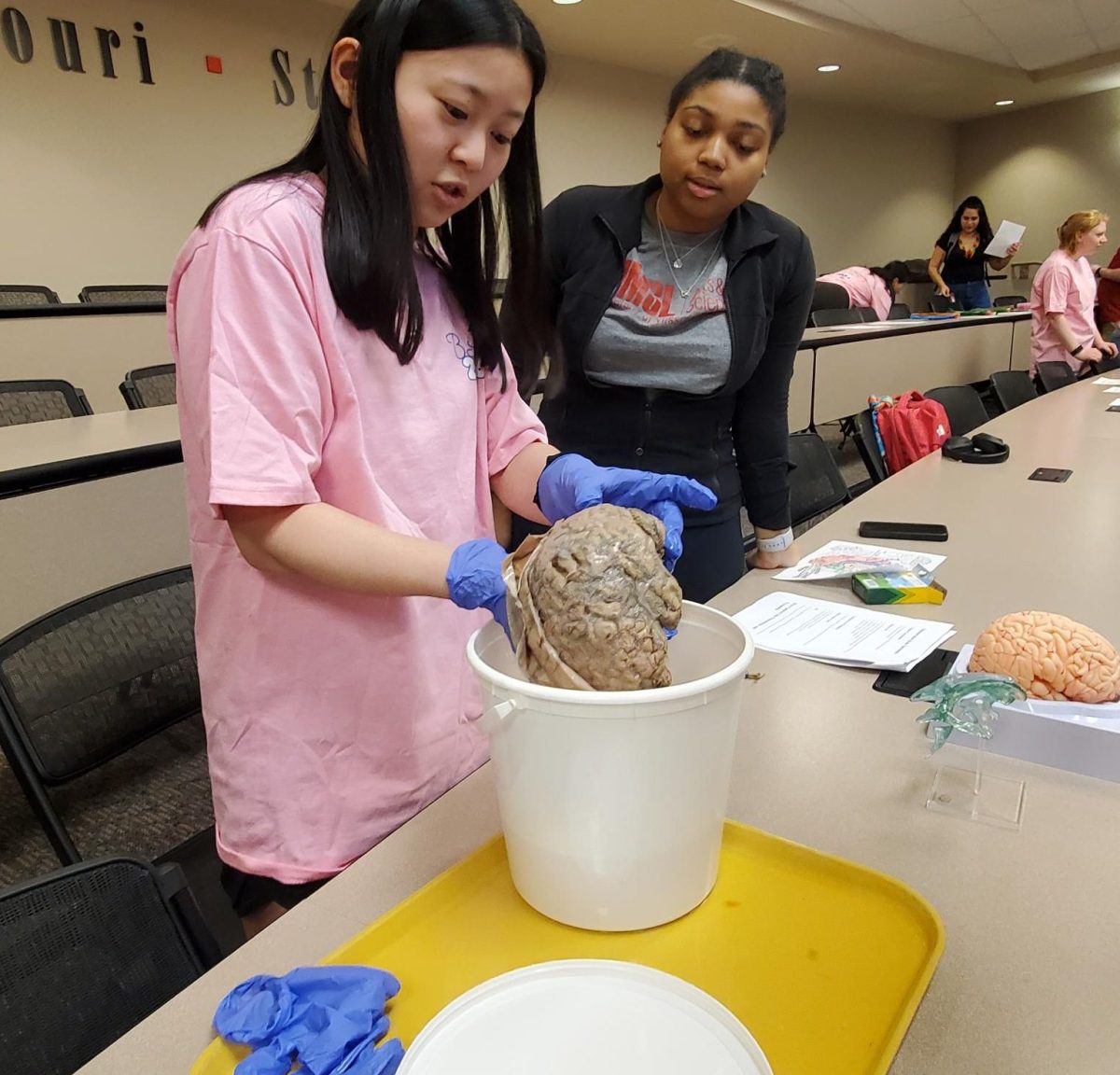
On March 20, the Millennium Student Center greeted students with human brains, electrodes hooked up to volunteers’ heads and students chewing strange-looking berries.
At first blush, this concoction of activities seems off-putting, but it’s actually part of UMSL’s Brain Awareness Week event, hosted by the Graduate Student Association of Psychology.
Brain Awareness Week was founded by the Dana Foundation in 1996 and has since turned into a worldwide initiative to educate the public about the inner workings of the human brain and the importance of neuroscience research. This year, Brain Awareness Week at UMSL was held from March 16 – 22.
This event was spearheaded by Magda Martínez-Mata and Caleb Sanders, two current psychology graduate students. Both had experience with Brain Awareness Week as undergraduates and wanted to put on their own event again. Last year’s event was a piloted version of Brain Awareness Week, with much less time and resources. After reflection and some revisions, Magda and Caleb revamped several activities and even applied for a grant with Dr. Carissa-Phillipi to bolster funds.
For both Magda and Caleb, this event holds great importance in reaching beyond the walls of academia and dispelling misinformation.
“Brain Awareness Week is an opportunity to share information with the community about things that interest them to help develop their understanding of themselves, ” said Caleb.
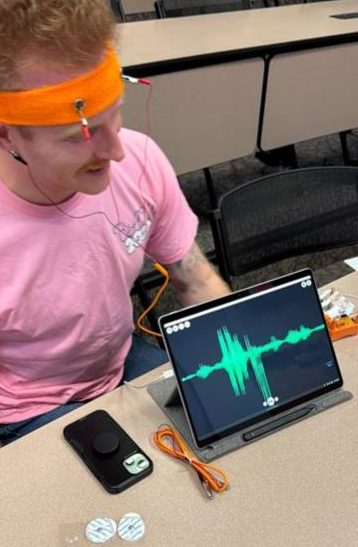
During the event, there were several stations, a human brain dissection explaining parts of the brain and their functions, crafts for making and understanding neuron cells, chewing miracle berries to temporarily alter taste perceptions and several electrode stations. These electrode stations involved stimulating and measuring the electrical activity of your muscles and brain, and using electrical signals to control a claw to pick up and drop objects. There was also a table to ask psychology graduate students about the brain and to inquire about graduate school opportunities.
This event benefited not only the undergraduate attendees by helping them learn about their brains, but also the psychology graduate students, who got to practice their science communication. A skill they will be using a lot in their careers as future clinicians, counselors and researchers.
Among all the entertaining activities and opportunities to ask questions about brain health, Caleb hopes attendees took away a few things from the experience: “If I could boil it down to three things. I hope people leave with a better understanding that neuroscience, psychology (and) brain science is relevant to their everyday life. The brain is shaping everything about our world. I hope that people see science as approachable and engaging instead of being distant and disparate from what’s important to them. I hope that people take those opportunities to develop whatever interests they have, even if it’s not brain-related (and) realize that they have opportunities to work in the areas they’d like to.”
The extra time and budget put into UMSL’s second Brain Awareness event provided a variety of hands-on activities and learning opportunities, and was well attended and received by participants.