










Opening a search engine, going on social media and reading an email; all of these digital spaces are now incorporating artificial intelligence, or AI, into their user interfaces. Alongside digital spaces, our in-person aspects of society, such as contemporary education, are facing controversial integrations of digital tools and AI into classrooms. This leaves many teachers unsure whether to reject or embrace these tools.
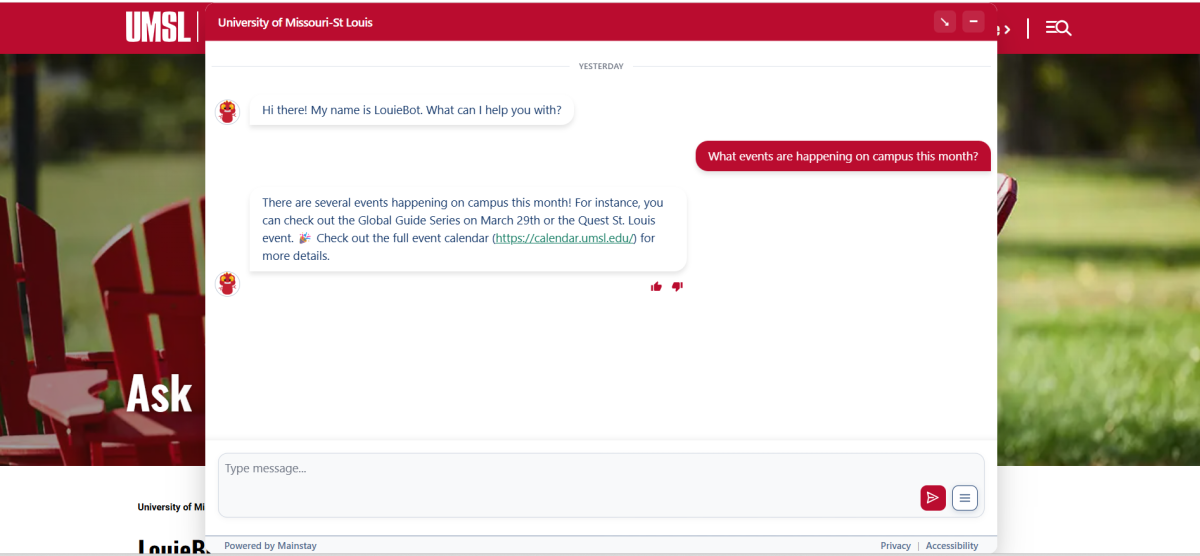
UMSL has created an AI program called LouieBot that students can use to ask questions and communicate with the school. Students can interact with LouieBot through the website and via text messages.
Artificial intelligence has been rapidly inserted into every industry and aspect of life, forcing us to adapt in many ways. As universities serve as a stepping stone to the workforce, should colleges accept or reject the use of AI found everywhere else? According to the Pew Research Center, 21% of workers in the United States report that some of their tasks are completed with AI. This certainly may put pressure on college graduates unfamiliar with the technology to adapt in the workforce.
Universities across Missouri have begun to offer degrees and certifications in artificial intelligence and data. These opportunities arose from the rapidly changing environment of many industries incorporating AI. In the article “UM System Board of Curators approves AI degrees for MU, UMKC” from KOMU8, Jacob Siciliano says, “MU believes these degrees will prepare students to enter a wide range of industries and roles.”
The cybersecurity, supply chain, medical diagnostics and software development industries are just some of the fields incorporating AI. According to KCTV 5, UMKC is planning on adding a bachelor’s degree in artificial intelligence, which is currently awaiting approval.
The University of Missouri-St. Louis has recently added a graduate certificate in artificial intelligence. To earn the certification, students must complete 12 credit hours, six in required courses and six in related electives. UMSL’s website states this certification “provides skills and training necessary to start and/or advance in the growing areas of AI, with a range of electives to focus more specifically in one’s desired direction of study.” This certification is offered to computer science and cybersecurity majors.
Looking at UMSL’s artificial intelligence page, students can find which programs are approved for schoolwork. Microsoft 365 CoPilot, ChatGPT (paid edition), Microsoft Teams Premium, Zoom AI Companion, Grammarly for Education, Google Gemini and NotebookLM are all approved to assist students by offering notetaking abilities, summarization tools and text generation. The free versions of ChatGPT and Otter.AI are the only programs not recommended and approved, while TeamDynamix Conversational AI and Apple Intelligence are under review.
In 2025, UMSL launched a collaboration with Scale AI. According to Scale’s blog, “the partnership accelerates members of Scale’s workforce toward earning university-level geospatial credentials while broadening their skill sets to deliver AI-ready geospatial datasets to national security customers.” In addition to offering current Scale employees the opportunity to continue their education, Scale will work to interact with undergraduate students. UMSL Blog says, “Scale and UMSL will bring together Scale’s workforce on UMSL’s campus to connect with GIS (Geographic Information Systems) students in events such as Lunch and Learns, YouthMappers chapter meetings and other special programs, including UMSL’s Geospatial Summer Camps. Scale also plans to create job opportunities for UMSL graduates at Scale’s St. Louis AI Center.
With extensive developments in AI, professors must adjust how they teach and communicate with students. English Department Chair, Lynn Staley, discusses how professors should view AI, saying, “We can’t serve them well if we are afraid of the technology. We have to understand how it synthesizes ideas.”
Staley also mentions the good AI can do for students: “It’s a really good tool for students to organize their thoughts. For outlining, for preparing, you can use it to help you organize information. For example, I teach business writing. I ask my students to, when they think about an assignment, plug the assignment into AI and see how that tool will help them organize their thoughts. They need to assess it and see if they agree with the AI. Then I ask them to write the assignment on their own.”
Staley summarizes how AI should be viewed: “using it as a tool, rather than a crutch, is how we need to look at it.” Between AI certifications, partnerships and approved programs for student use, artificial intelligence at the University of Missouri-St. Louis has expanded over the last couple of years. However, with the ever-changing technology landscape, students and teachers will have to continue adapting to new changes and developments in AI.